NFL Spread Picks: How to Read, Analyse and Beat the Point Spread
 Available in US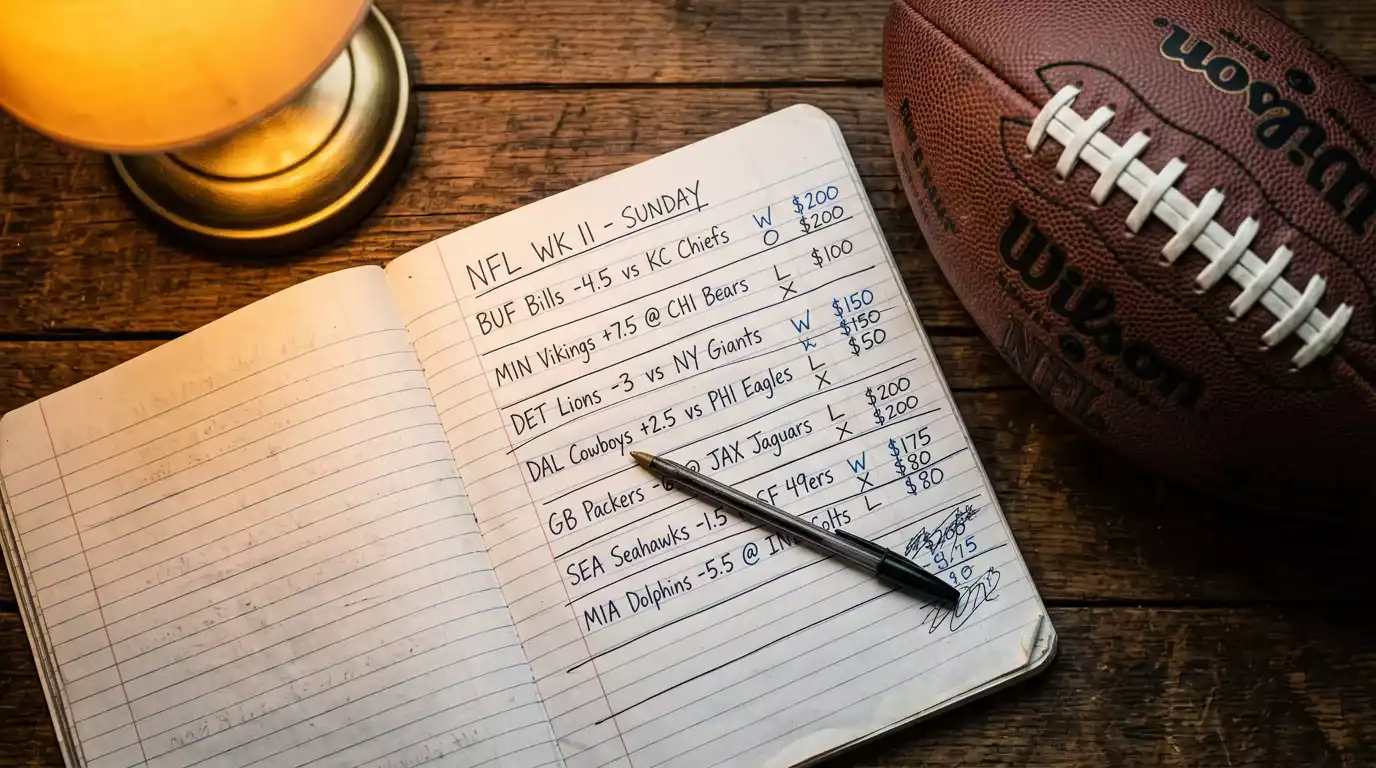
The point spread is the first market I ever learned to read, and nine years later it is still the one I come back to more than any other. There is a reason for that. According to Optimove’s NFL Wagering Intentions Report, 61% of NFL bettors prefer the spread over moneyline or totals, because it flattens the talent gap between teams and forces you to think about margin, not just the winner. For UK punters raised on football match odds and Asian handicaps, the NFL spread is surprisingly intuitive once you strip away the American terminology. The mechanics are almost identical to a handicap bet at any UK-licensed bookmaker, just wrapped in a different vocabulary.
What makes the spread worth studying is not simplicity, though. It is depth. Every NFL spread encodes information about injuries, public sentiment, coaching tendencies and weather, and that information shifts throughout the week. If you can learn to read those shifts, you stop guessing and start analysing. This guide breaks the spread down into its moving parts, explains the numbers that matter most, and shows you how to spot the edges that UK bookmakers still leave on the table.
I have built my entire workflow around spread analysis. Not because it is the only profitable market, but because it is the most transparent one. The data is public, the line movement is trackable, and the historical patterns are deep enough to test properly. Whether you are placing your first handicap bet on a Sunday evening or refining a system you have run for years, the spread rewards discipline over guesswork – and that is exactly the approach I want to walk you through here.
Table of Contents
- How NFL Point Spreads Work
- Key Numbers in NFL Spread Betting: 3, 7 and 10
- What Moves an NFL Spread During the Week
- ATS Trends That Matter: Divisional, Home Underdog and Late-Season
- Reading NFL Spreads at UK Bookmakers
- Common Spread Betting Mistakes and How to Avoid Them
- The Spread Rewards Process Over Prediction
How NFL Point Spreads Work
A few years ago I sat in a pub in Manchester watching the Chiefs play the Jaguars with a mate who had never placed an NFL bet. He looked at the line – Kansas City -7.5 – and asked, “So they have to win by eight?” That single question captures the entire concept. The point spread is a number set by bookmakers to create a roughly even market on both sides. The favourite “gives” points and the underdog “receives” them. If you back Kansas City at -7.5, they need to win by eight or more for your bet to land. Back Jacksonville at +7.5 and they can lose by up to seven points and you still collect.
The spread exists because most NFL games are not competitive enough on the moneyline to attract balanced action. Nobody wants to lay -350 on a heavy favourite for a marginal return, and very few punters want to back a three-touchdown underdog at +280 either. The spread evens things out. Both sides are typically priced around -110 in American odds, which translates to roughly 1.91 in decimal – close to evens with a small margin built in for the bookmaker.
At UK bookmakers, you will usually see this market labelled as “handicap” rather than “spread.” The pricing might appear in fractional or decimal format instead of American, but the underlying bet is identical. A -7.5 spread at -110 is the same as a -7.5 handicap at 10/11. The only real difference is presentation. Once you accept that equivalence, every piece of US-focused spread analysis becomes directly usable at your UK betting account.
One detail that catches newcomers: half-point spreads eliminate the possibility of a push. If the spread is -7, Kansas City winning by exactly seven means every bet is refunded. Nobody wins, nobody loses. At -7.5, that cannot happen. Bookmakers in the UK lean towards half-point lines, which simplifies things. You either win or you lose, and there is no limbo in between.
The spread also moves. It opens early in the week, typically on Sunday evening or Monday morning UK time, and shifts as money comes in, injury news breaks and sharp bettors take positions. That movement is information, and reading it properly is one of the most valuable skills in NFL betting. I will get into the mechanics of line movement later, but for now the key point is this: the spread you see on Tuesday is not necessarily the spread you will see at kickoff.
Key Numbers in NFL Spread Betting: 3, 7 and 10
Not all numbers on the spread are created equal. I learned this the hard way during my second season of serious NFL betting, when I kept taking -3.5 without realising I was crossing the most important threshold in American football. The number 3 matters because a field goal is worth three points, and an enormous share of NFL games are decided by exactly that margin. When you back a team at -3, a three-point win pushes your bet. At -3.5, that same result is a loss. The gap between -3 and -3.5 is not half a point. It is a canyon.
The number 7 is the second pillar. A touchdown plus an extra point equals seven, and a significant percentage of NFL results land on that number. Games decided by exactly seven points are common enough that the difference between -7 and -7.5 has measurable long-term impact on your win rate. After 3 and 7, the number 10, a touchdown plus a field goal, is the next most frequent margin. These three figures account for a disproportionate share of final score differentials across decades of NFL data.
Why does this matter practically? Because the price you pay to move through a key number should be much higher than the price of moving through a non-key number. If a bookmaker offers you -2.5 versus -3, or -6.5 versus -7, you are buying your way off a key number and that is enormously valuable. If they offer you -4.5 versus -5, the value of that half-point is significantly smaller because far fewer games land on exactly four or five points.
Pickswise’s analysis of recent NFL seasons found that unders bets in divisional matchups hit at a 57% rate, and that trend strengthened from Week 13 onward, precisely the period when games tighten and margins cluster around key numbers. Late-season divisional games are lower scoring and more likely to land on 3 or 7 because both teams know each other’s schemes intimately. Defensive coordinators have twice as much film to study for the second meeting, and that familiarity compresses scoring.
I keep a simple rule in my workflow: never cross 3 or 7 without getting paid for it. If a line sits at -3 and I think the true number is -3.5, I take -3 and accept the push risk rather than buying up to -3.5 at a worse price. Over a full season, that discipline compounds. You will not notice it in any single week, but across 200 or 300 bets per year, staying on the right side of key numbers is one of the simplest edges available.
What Moves an NFL Spread During the Week
I once watched a spread move from -3 to -6.5 between Tuesday and Sunday, and the cause was a single MRI result. The starting quarterback had torn his ACL in practice, the backup was a journeyman with six career starts, and the market repriced the entire game within hours. Injury news is the single biggest mover of NFL spreads, and it is the factor that UK bettors can exploit most directly because of time zones. More on that shortly.
Shaun Stack, a senior NFL analyst at Gambling Nerd, puts it well: he tries to account for as many factors as possible, from usage rates and schemes to weather and a coach’s job security. That layered approach reflects what bookmakers themselves do when they set and adjust a line. The opening spread is based on power ratings, historical matchup data and projected rosters. From there, three forces push it around.
The first is money. When the public loads one side of a game, bookmakers adjust the line to balance their exposure. If 75% of the money lands on the favourite, the spread widens to attract action on the underdog. The second force is sharp money – large, precisely timed wagers from professional bettors or syndicates. Sharp money tends to come in early (Sunday night, Monday morning) or very late (an hour before kickoff), and bookmakers respect it more than public money because these bettors have long track records of profitability. The third force is news. Injuries are the headline, but coaching changes, weather forecasts, travel disruptions and even locker-room stories can shift a line.
For UK-based bettors, the timing of NFL injury reports creates a genuine structural advantage. The NFL requires teams to publish injury designations on Wednesday, Thursday and Friday of each game week. Those reports drop in the late afternoon or early evening US Eastern time, which is late evening or night in the UK. By the time US-based recreational bettors wake up and react the next morning, hours have passed. If you are checking injury reports at 10pm or 11pm UK time, you are seeing the same information that professional US bettors see, and you have the same window to act before the wider market adjusts.
Weather is another underrated mover that gets announced late. Wind speed forecasts for outdoor stadiums can shift totals dramatically, but they can also move spreads when one team relies heavily on the passing game. A 25-mph crosswind at Soldier Field benefits a run-heavy team and punishes a pass-first attack. Bookmakers know this, and the spread will move once game-day weather reports confirm conditions. Again, the timing benefits attentive UK punters who are willing to check forecasts before bed on a Saturday night.
ATS Trends That Matter: Divisional, Home Underdog and Late-Season
Trends get a bad reputation in betting circles, and most of the time that reputation is deserved. “Team X is 8-2 ATS in their last ten road games” is the kind of stat that sounds impressive but tells you almost nothing about the next game. The roster has turned over, the coach might be different, and the sample is too small. I ignored trends entirely for my first few years. Then I started looking at situational categories with larger samples and clearer causal logic, and my approach changed.
Divisional games are the trend I trust most. When two teams play each other twice a year, the second meeting is a different animal. Defensive coordinators have a full game of current-season film to study. Scheme adjustments are sharper, and surprise plays, the trick formations, the unusual personnel groupings, are largely spent. The result is lower-scoring, tighter games. Underdogs cover more frequently in divisional rematches because the knowledge gap narrows. If Team A blew out Team B by 17 in Week 5, the bookmaker might set a similar spread for the Week 14 rematch, but Team B’s coaching staff has spent nine weeks preparing counters. The 57% win rate for unders in divisional games, particularly from Week 13 onward, reflects this dynamic. I factor divisional context into every spread I evaluate during the second half of the season.
Home underdogs are the second pattern worth tracking. NFL home underdogs cover at a rate that has remained consistently above breakeven across decades of data. The causal logic is straightforward: crowd noise disrupts opponent communication, familiarity with the playing surface helps, and travel fatigue, including domestic travel in the US, takes a marginal toll. The edge is not enormous, but it is real and persistent. It becomes sharper when you add situational filters. A home underdog in a divisional game, late in the season, in cold weather at an outdoor stadium, has a meaningfully better ATS record than a generic home underdog.
Late-season football behaves differently from September ball. By Week 13, bad teams have often mentally checked out, but their players still know the scheme. Teams fighting for a playoff spot play with intensity that is not fully reflected in power ratings based on early-season performance. This mismatch – motivated underdogs facing spreads built on season-long averages – creates opportunities. I increase my bet volume slightly in Weeks 14 through 18, not because I become less selective, but because the number of exploitable lines tends to grow.
One trend I actively avoid is anything based on a specific team’s recent run. “The Bills are 6-0 ATS in December” is noise. What matters is the structural context: divisional opponent, home or away, indoor or outdoor, rest advantage, and where the line sits relative to key numbers. If those structural factors align, the trend has teeth. If the only argument is a team’s recent hot streak against the spread, the trend is probably already priced in. Bookmakers read the same articles you do, and they adjust their lines accordingly. The edges that survive are the ones grounded in repeatable game theory, not in streaks that sound good on a podcast.
For a deeper look at how ATS trends create value betting opportunities in NFL markets, the analytical framework transfers directly – the same logic that identifies a mispriced spread also identifies a positive expected value bet.
Reading NFL Spreads at UK Bookmakers
The first time I tried to find an NFL spread at a UK bookmaker, I searched for “spread” and found nothing. The market was listed under “handicap,” specifically “match handicap” or “alternative handicap.” If you are used to the American terminology, the translation takes about five minutes to learn and then never causes problems again.
UK bookmakers display NFL handicaps in decimal or fractional odds by default, though most allow you to switch to American format in your account settings. A -7.5 spread priced at -110 in the US appears as 1.91 decimal or 10/11 fractional. The payout is identical. The UK Gambling Commission’s industry statistics for 2025 showed that the broader UK gambling market generated 16.8 billion pounds in gross gambling yield, a 7.3% year-on-year increase, which means competition among operators is fierce. That competition benefits NFL bettors because bookmakers fight for your business with tighter margins, enhanced odds and accumulator bonuses.
Market depth varies across operators. Some UK bookmakers offer alternative handicap lines – -3.5, -6.5, -7.5, -10.5 – on every NFL game, which lets you shop for key numbers. Others offer only the primary line. If you are serious about spread betting, having accounts at three or four UK-licensed operators is not paranoia; it is basic toolkit maintenance. The half-point difference between -3 and -3.5 can be the difference between a winning and a losing season.
Timing matters too. UK bookmakers tend to post NFL lines slightly later than their US counterparts, sometimes not until Monday afternoon for the following Sunday’s games. Once the lines are live, they track US market moves fairly closely, but there can be brief windows – particularly around injury announcements – where a UK operator has not yet adjusted while the US market already has. Those windows are narrow, rarely more than an hour, but they exist and they reward attentiveness.
One practical note: if you are comparing a UK bookmaker’s handicap line to an American source, make sure you are comparing the same market. Some UK operators include overtime in their handicap settlement, while others settle on regulation time only. The difference is rare but consequential. Check the market rules before you place the bet, not after.
Common Spread Betting Mistakes and How to Avoid Them
I have made every mistake on this list at least once. The most expensive was chasing a spread after a bad beat. I had taken a team at -6.5, watched them lead by ten with two minutes left, and then saw a garbage-time touchdown cut the margin to three. My bet lost. The next week I doubled my stake on the same team to “get it back.” That is not analysis; that is emotion wearing an analytical costume. Optimove’s research found that 63% of NFL bettors admit to spending more than they can afford, and I suspect a significant share of that overspending is fuelled by exactly this kind of reactive, revenge-driven betting.
The second common mistake is ignoring key numbers. I covered this earlier, but it bears repeating in the context of errors. Taking -3.5 when -3 is available elsewhere is not a minor oversight. Over a season, the cluster of games decided by exactly three points will punish you repeatedly. The same applies to -7.5 versus -7. Always check at least two or three UK bookmakers before locking in a spread bet. The extra sixty seconds of comparison can save you hundreds of pounds across a season.
Third: betting every game. A full NFL Sunday slate has up to 14 games. The temptation is to have a view on all of them, and once you have a view, the temptation is to bet it. I spent an entire season doing this and my results were mediocre. When I cut my volume to four or five spread bets per week – the ones where my analysis genuinely diverged from the market – my win rate jumped by roughly four percentage points. Selectivity is not about betting less for the sake of discipline. It is about allocating your time and capital to the spots where your edge is real.
Fourth: overvaluing recent performance. A team that won their last three games by 20 or more points looks unstoppable, but the market has already priced that streak in. Their spread will be wider than it would have been three weeks earlier. Betting on momentum means betting at inflated prices. I look for the opposite: teams coming off ugly losses where the public has overcorrected. If a team loses by 30 in a fluky game – a pick-six, a muffed punt, a freak injury in the first quarter – their spread the following week often overcorrects in the other direction. That overcorrection is where value hides.
Finally: not tracking results. If you cannot tell me your ATS record by market type, by conference, by month, you do not have a system – you have a hobby. Tracking sounds tedious, but it is the only way to identify whether your process is working or whether your confidence is just optimism in disguise. A simple spreadsheet – date, game, spread, result, profit or loss – takes two minutes per bet and gives you a season’s worth of data to review. Without that data, you are guessing about your own performance, and that is the most dangerous guess of all.
What are the key numbers in NFL spread betting and why do they matter?
The most important key numbers are 3, 7 and 10. These correspond to common scoring units in American football: a field goal (3 points), a touchdown plus extra point (7 points) and a touchdown plus a field goal (10 points). A disproportionate number of NFL games are decided by exactly these margins, so the difference between backing a team at -3 versus -3.5 has a measurable long-term impact on profitability. Always check whether you can stay on the favourable side of a key number before placing your bet.
How do I find NFL spreads at UK bookmakers like Sky Bet or bet365?
UK bookmakers list NFL spreads under ‘handicap’ or ‘match handicap’ rather than ‘spread.’ Navigate to the American Football section, select the NFL, and look for the handicap market on any listed game. Most operators display odds in decimal or fractional format by default, but you can switch to American odds in your account settings. Alternative handicap lines at different point values are also available at many UK-licensed operators.
Should I bet the spread early in the week or wait until game day?
It depends on the type of edge you have identified. If your edge comes from a power rating or model that differs from the opening line, bet early before the market corrects. If your edge depends on injury news or weather conditions, wait until those factors are confirmed – typically Friday evening or Saturday for injuries, and Saturday night for weather. Early bets capture the best price before sharp money moves the line; late bets capture the best information.
What does it mean when an NFL spread moves from -3 to -3.5?
A move from -3 to -3.5 means more money has come in on the favourite, prompting the bookmaker to widen the spread to attract action on the underdog. This particular move crosses the key number of 3, which makes it especially significant. If you were considering the favourite, the price has worsened considerably. If you were looking at the underdog, +3.5 is a much better position than +3 because you now win on any game decided by exactly three points.
The Spread Rewards Process Over Prediction
Nine years of NFL spread betting have taught me that the punters who last are not the ones who predict scores most accurately – they are the ones who respect the process. Read the line. Understand what is moving it. Know your key numbers. Filter for the structural situations where the data says edges exist. Track everything. The spread is the most transparent market in NFL betting, and that transparency rewards anyone willing to do the work. You do not need to be right on every game. You need to be right on the games where you have a genuine reason to bet – and disciplined enough to sit out the rest.
Created by the ”nfl bet of the day” editorial team.